Pl. 06THE DRAWING
The Fool Has No Number, or the Number Is Zero
One card, two positions, and five centuries of editorial argument about where it belongs: the Fool, unnumbered or zero.

The Fool carries no numeral in the Marseille sequence — the gap is the whole argument.
Photo: Costumed participant holding chalice and The Fool tarot card at Wyldwood Renaissance Festival 2026 · Wikimedia Commons
A Number That Was Not There
In the earliest surviving trump sequences — the Visconti-Sforza pack among them — the Fool carried no numeral at all. The numbered trumps ran in a sequence; the Fool stood apart, neither first nor last in any formal sense, functioning more as a wild element outside the ranked order than as a member of it. The Marseille pattern, which standardised the major arcana as a commercial product across French and Italian printmaking from the seventeenth century onward, preserved this status: the Marseille woodblock tradition kept the Fool unnumbered, printed separately from the ranked sequence of I through XXI.
The zero came with the occultist current. When Éliphas Lévi mapped the trumps onto the Hebrew alphabet in the 1850s, the correspondence system demanded a tidy fit of twenty-two cards to twenty-two letters. Assigning the Fool the position of zero — or occasionally slotting it elsewhere in the sequence — was an editorial act, not a recovered tradition. By the time the Hermetic Order of the Golden Dawn codified its attributions in the 1890s, the Fool as zero was effectively doctrine within that milieu.
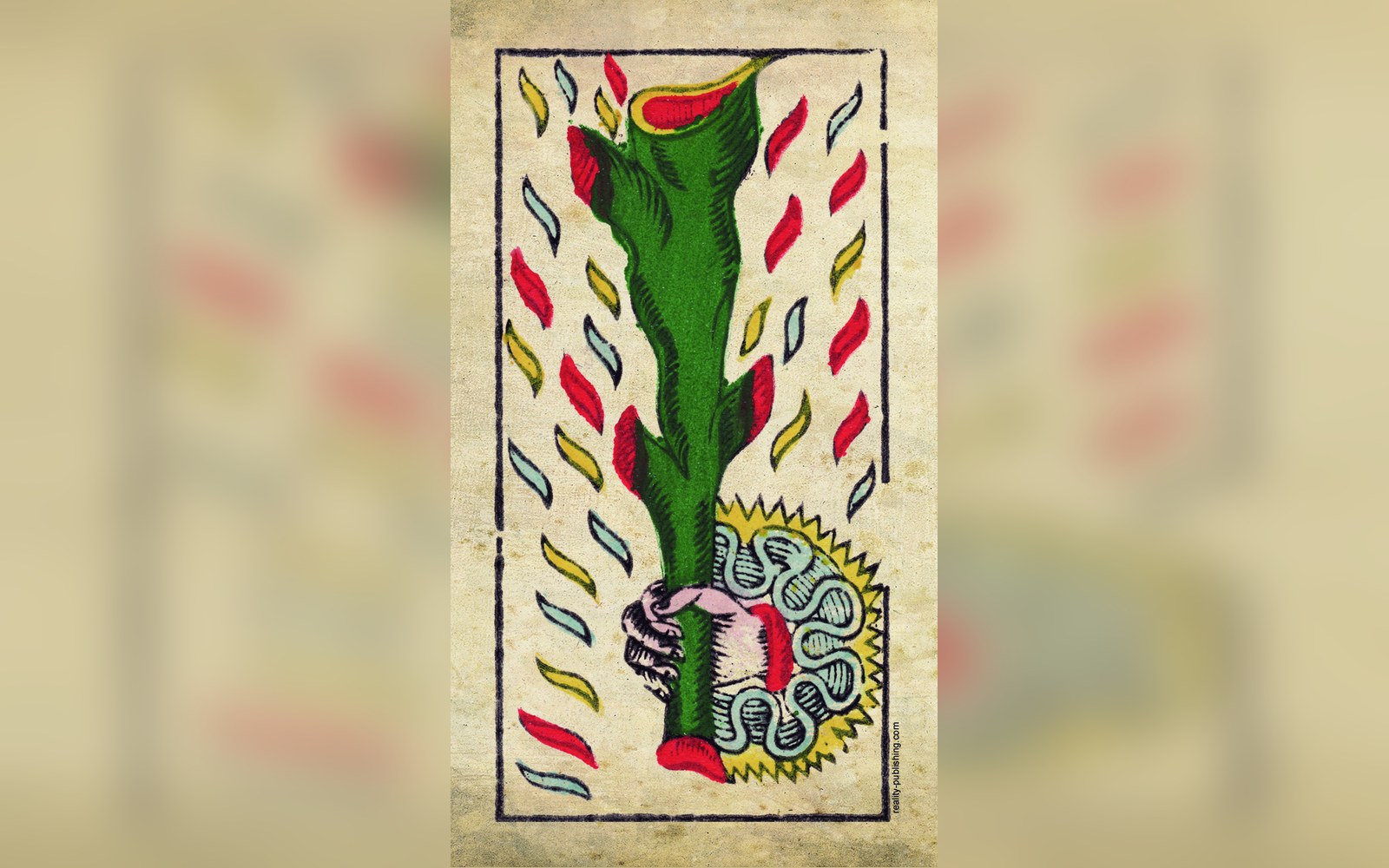
A pull from the Conver line — the Ace of Batons, still in print.
Photo: As BATON Nicolas Conver Tarot 1760 · Wikimedia Commons
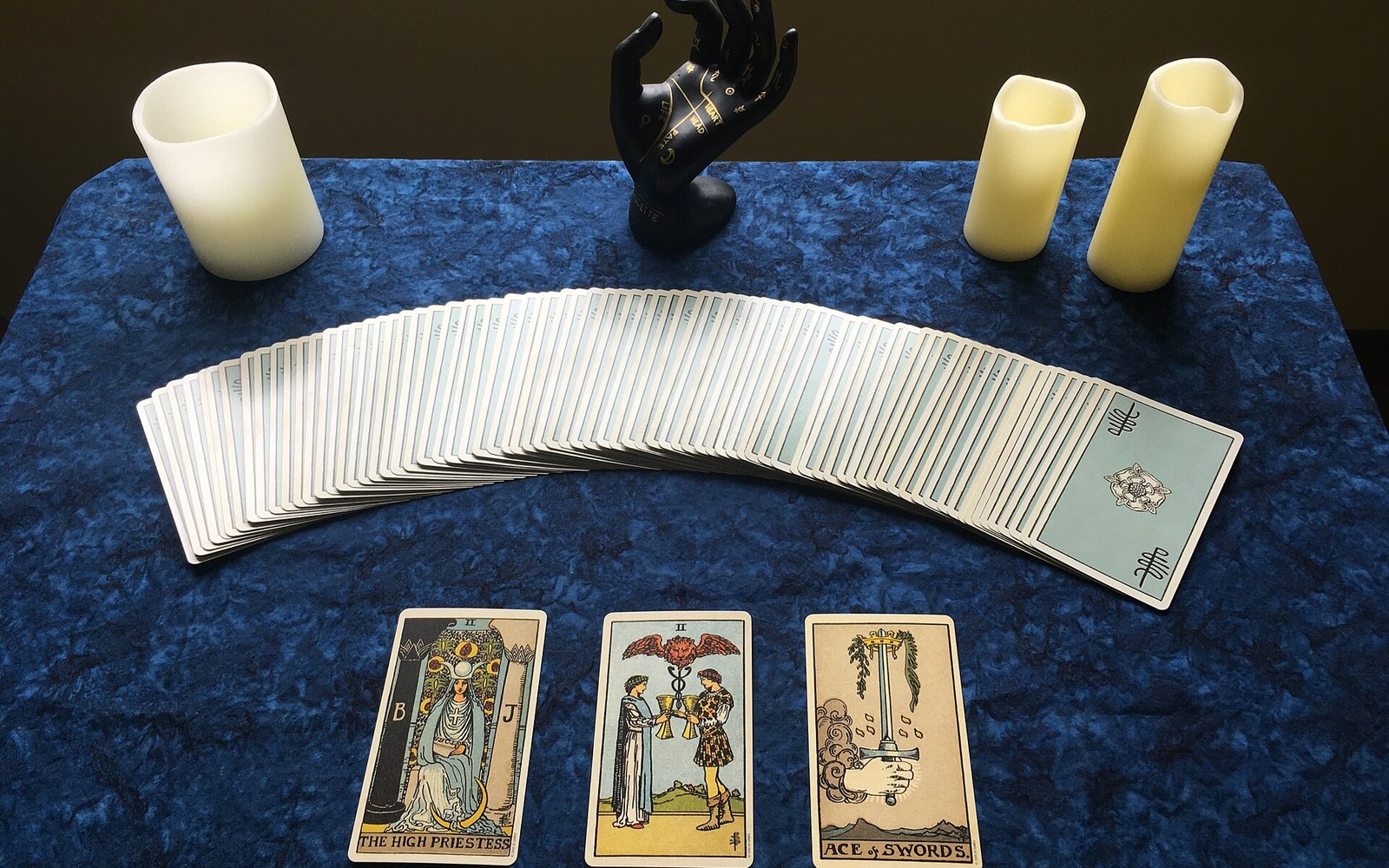
Twenty-two plus fifty-six: a count that hardened into a standard.
Photo: Tarot cards - 3 card spread with candles · Wikimedia Commons
Arthur Edward Waite and Pamela Colman Smith accepted that assignment when producing their 1909 deck for William Rider and Son. The Rider-Waite-Smith pack printed 0 on the Fool's card, fixing the convention for every mass-market deck that followed it into the twentieth century. The numeral is now so expected that decks omitting it tend to note the choice as a deliberate return to earlier practice.
The downstream effect was not trivial. Whether the Fool sits at the sequence's beginning as card zero, floats outside it without a number, or — as some nineteenth-century French arrangements placed it — appears near the end between XX and XXI, determines how designers visualise narrative arc across the full twenty-two. It also, more prosaically, determines how decks are indexed in the seventy-eight-card standard that publishers now treat as fixed. The number zero on one card is a publishing decision that has quietly shaped the layout of millions of printed objects.