Pl. 01THE DRAWING
Paid Once, Still in Print
Pamela Colman Smith illustrated seventy-eight cards for a flat fee in 1909. The deck bears her name today; the copyright revenue it generated for over a century did not reach her.
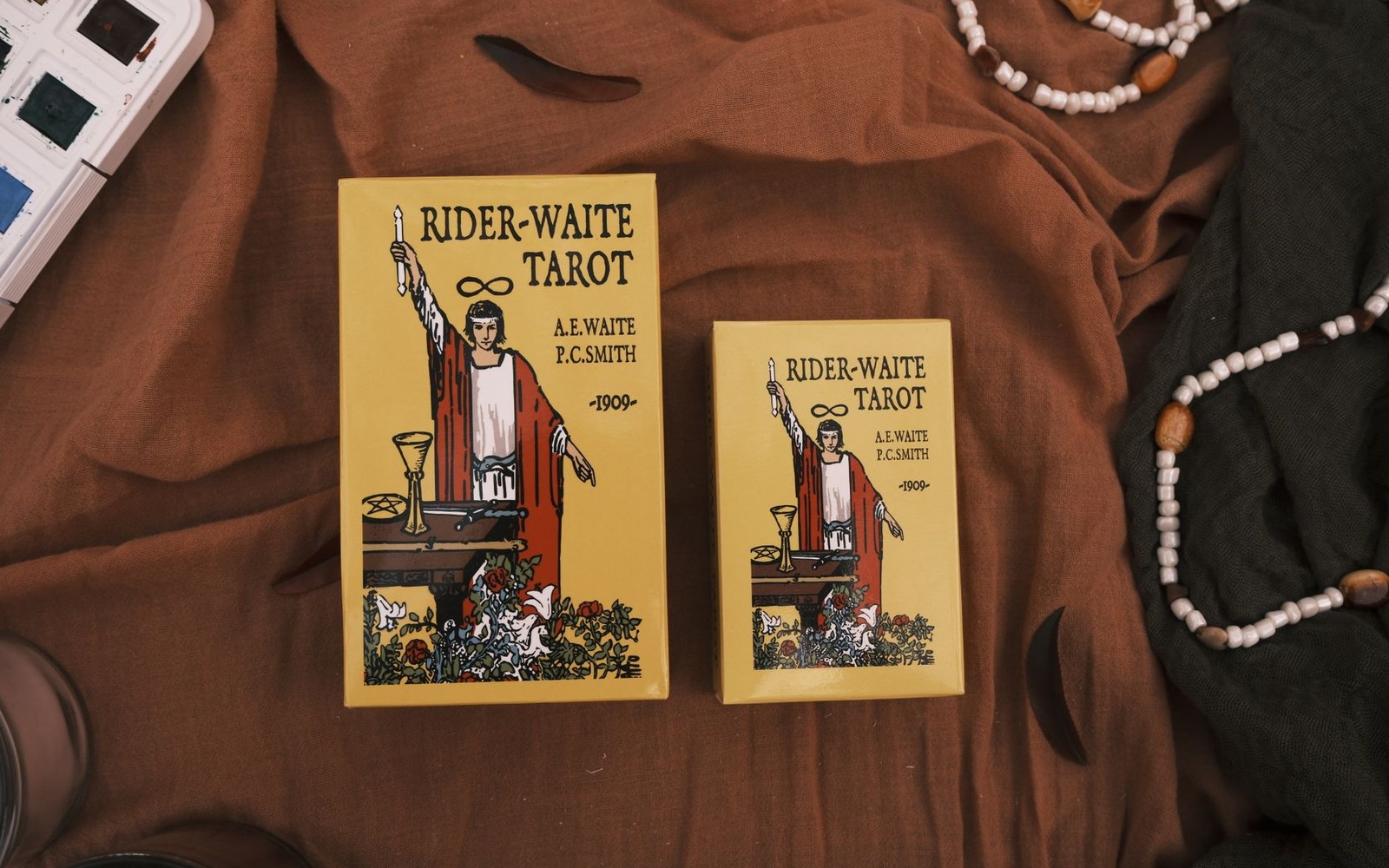
An early Rider printing. The illustrator’s name is not on the box.
Photo: dilara irem / Pexels
A Career Before the Cards
Pamela Colman Smith was not an unknown when Arthur Edward Waite approached her in 1909. Born in London in 1878 to a Jamaican-American father and an English mother with Jamaican roots, she had spent formative years in Jamaica and Brooklyn before enrolling at the Pratt Institute in Brooklyn in the mid-1890s. The school trained commercial illustrators as well as fine artists, and Smith absorbed both: her line work was fluent and her compositional instincts theatrical, shaped partly by years spent assisting the actor-manager Henry Irving's company at the Lyceum Theatre in London. She absorbed staging, costume and the grammar of symbolic gesture from professional theatre, and that education shows in every tableau of the finished deck.
Her publishing record before the Rider commission was substantial. In 1903 she founded and edited The Green Sheaf, a short-lived but serious illustrated literary magazine that ran to thirteen issues and featured contributions from W.B. Yeats, among others. Smith designed, illustrated and hand-coloured portions of the publication herself, demonstrating both her reproductive knowledge — she worked with stencil, block and print processes — and her appetite for the intersection of text and image. The magazine closed for financial reasons within about two years, but it had circulated in London literary circles and established Smith as a figure of some standing in the arts-and-crafts world of Edwardian print.
Her fine-art career was equally active. In 1907, Alfred Stieglitz gave her an exhibition at his 291 Gallery at 291 Fifth Avenue in New York — a space that would shortly champion Picasso, Matisse and Rodin in America. Smith's show, of works described at the time as synesthetic, drawn in response to music, was a genuine critical event, not a fringe curiosity. She was a full member of the Hermetic Order of the Golden Dawn, through which she knew Waite, and her symbolic vocabulary — derived from Western esoteric tradition, theatre and Caribbean cultural memory — was already highly developed when the commission arrived.
The Commission and Its Terms
The terms under which Smith drew the seventy-eight cards are not preserved in a surviving contract, but the financial structure is documented in outline: she was paid a flat, one-time fee by William Rider and Son of London, and she received no royalties. The rate has not been confirmed from primary sources, and no figure should be invented, but contemporaneous accounts and subsequent scholarship agree that it was modest, commensurate with ordinary commercial illustration work of the period rather than with a creative commission that carried publishing rights. The deck was published in December 1909 under the title The Rider Waite Tarot — or in some early printings, simply the Rider Pack — naming the publisher and the occult editor who briefed her, not the illustrator who produced every image.
Waite provided the conceptual framework: which figures should appear on which cards, what symbolic attributes they should carry, how the sequence should be ordered. What Waite's brief specified and what Smith actually drew are not identical, and the gap between the two is significant — the fully illustrated minor arcana, the most radical innovation of the 1909 deck, are far more her invention than his brief required. Before 1909, the numbered suit cards in tarot decks displayed repeated pip symbols arranged geometrically. Smith gave each of the fifty-six minor arcana a figured scene, a decision that transformed how readers engaged with the pack and that accounts for much of its enduring utility as a visual reference for subsequent illustrators.
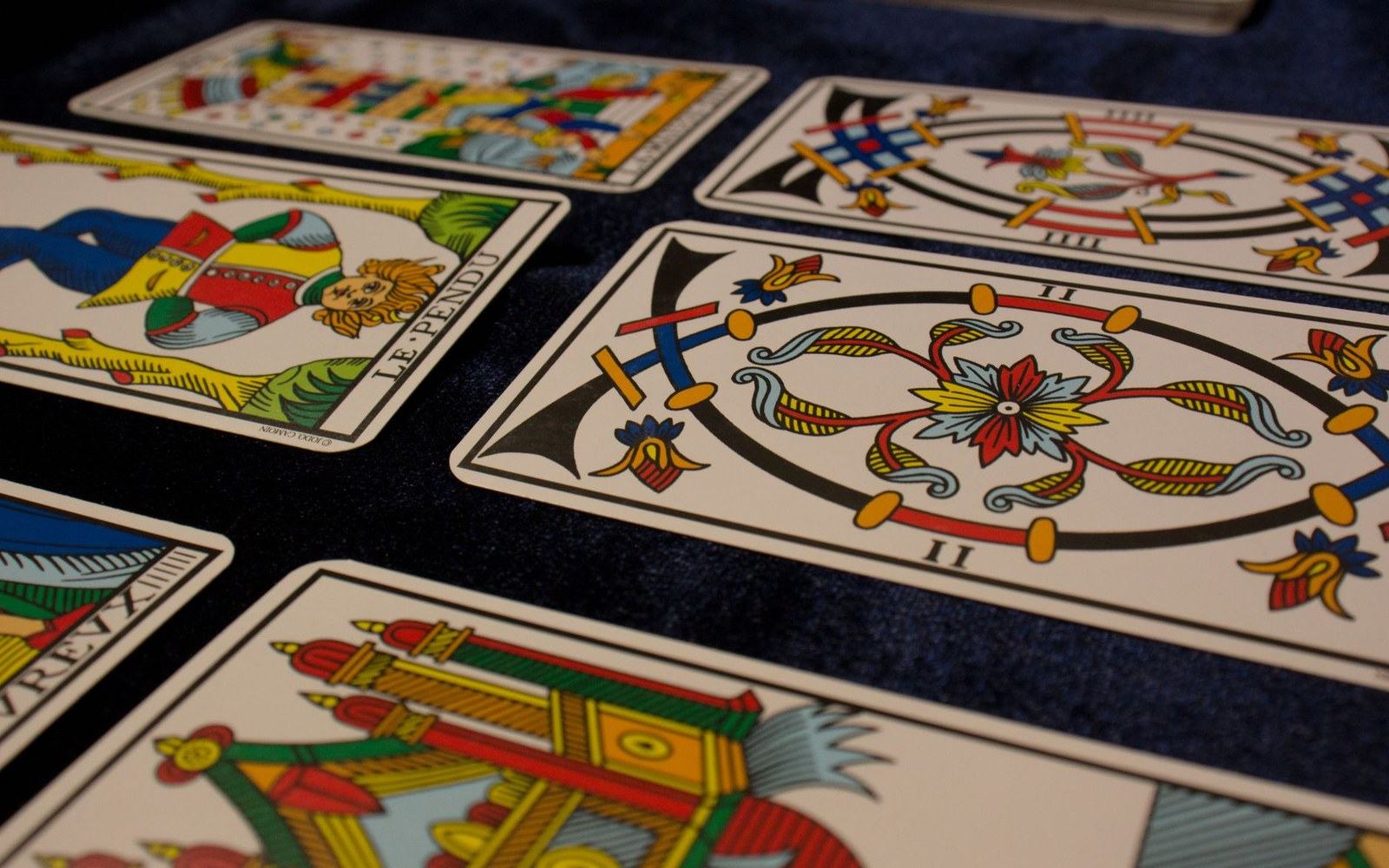
Before 1909 a numbered suit card looked like this: the symbol, repeated, arranged.
Photo: Pedro Rey / Pexels
William Rider and Son retained the copyright in the images as a work made for hire. When the firm was absorbed into successive publishing entities through the twentieth century, those rights passed with it. U.S. Games Systems, the Connecticut company founded by Stuart Kaplan in 1968, eventually became the principal rights-holder of the Rider-Waite trade dress — the visual appearance and overall presentation of the deck as a commercial product. Smith died in 1951 in Cornwall, where she had lived in reduced circumstances for some years, having converted to Catholicism in 1911 and largely withdrawn from the London art world. No estate to speak of survived her.

Ink, a nib, a board: on the illustrator’s side of the 1909 deck, this was the entire production apparatus.
Photo: Katya Wolf / Pexels
When Her Name Arrived
The title history of the deck tracks the gradual acknowledgment of Smith's authorship as a production fact rather than a moral reckoning. Early printings identified the pack by publisher and editor: "Rider" gestured at the printer, "Waite" at the intellectual authority behind the esoteric system. Smith was credited in the booklet that accompanied the cards, but her name did not appear on the deck itself.
The formulation "Rider-Waite-Smith" — now the standard scholarly and trade designation — gained currency in the late twentieth century, partly through the advocacy of researchers and historians who argued that omitting the illustrator's name from a visual artefact was historically incoherent. Stuart Kaplan, whose encyclopedic Encyclopedia of Tarot documented the deck's printing history in detail across multiple volumes beginning in 1978, was instrumental in building the scholarly infrastructure within which Smith's contribution became impossible to overlook. The shift from "Rider-Waite" to "Rider-Waite-Smith" in mainstream usage is a textbook case of attribution recovering ground lost to original commercial practice.
The copyright situation, by contrast, has not recovered ground for Smith's heirs — there are none with a legal claim. The images entered the public domain in the United Kingdom and the United States at dates determined by the relevant copyright terms of the jurisdictions involved, and by the circumstances of the work's creation and first publication in 1909. The original Rider edition, reproduced photographically, is the basis for the many public-domain reprints now available. The trade dress — the specific coloration, card-back design, titling and packaging conventions associated with the proprietary U.S. Games edition — remains protected separately from the underlying images. Publishers who reprint the Smith images without reproducing that dress may legally do so; the images themselves are free.
The Deck as a Print Object
The 1909 deck was printed by lithography on card stock appropriate to playing-card manufacture of the period. Early printings were not uniform: paper weights, ink densities and colour fidelity varied between editions, and the print history of the Rider-Waite is itself a specialist subject, with collectors distinguishing early English printings from later American ones on the basis of tonal differences in key cards. The standard pack contains seventy-eight cards — twenty-two major arcana and fifty-six minor — a structure that had been codified in Western occult tradition before Smith's deck but that her illustrated minor arcana made newly accessible to a mass audience.
Smith completed the drawings, by most accounts, in under six months. She worked in ink and watercolour, producing images that had to survive reduction to playing-card scale and reproduction by the commercial printing technology available in 1909. That they remained legible, expressive and compositionally coherent at that scale is a technical achievement as much as an artistic one. The deck has been in continuous print since its first publication. Smith drew it once, was paid once, and the press has not stopped.