Pl. 04THE DRAWING
Harris Repainted the Magus Until Crowley Stopped Asking
The Thoth Tarot took five years to paint, and one card — the Magus — was never settled. The published deck carries three printed versions because the commission's revision cycle outlasted Crowley's patience.
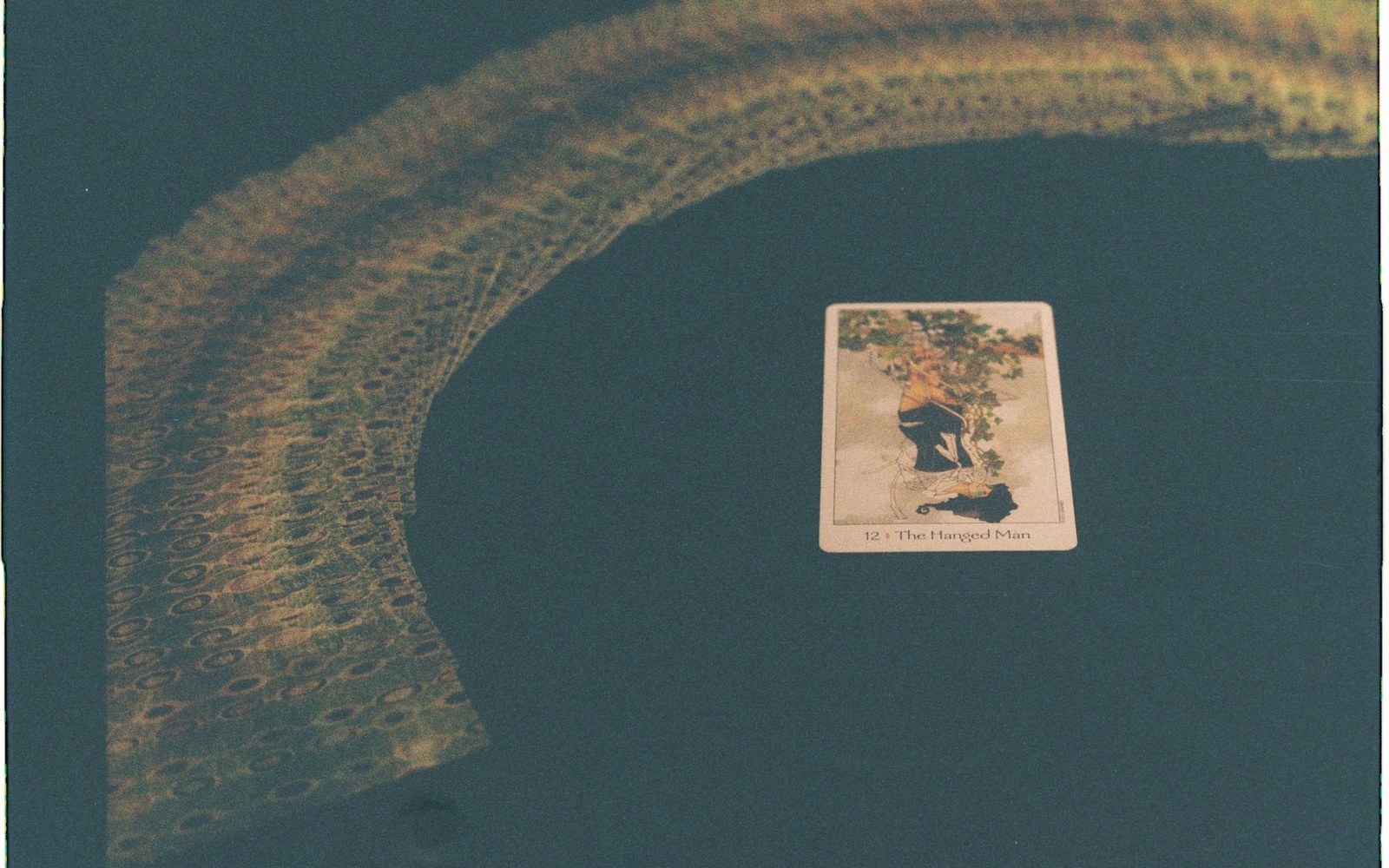
Harris worked in watercolour on board, well above printed card size.
Photo: Uyen Nguyen / Pexels
The Commission and the Method
Lady Frieda Harris came to Aleister Crowley in 1937, seeking instruction in his system of ritual magic. What she received instead — or alongside — was a brief to paint a new tarot deck. The terms were informal: Crowley would direct the iconography and write explanatory text; Harris would execute the images. No publisher was contracted from the outset, and no fee schedule appears in the surviving record. Harris funded her own materials and gave years of labour on an arrangement that amounted, in practice, to a speculative collaboration.
Harris was not a commercial illustrator. She had trained in painting and, by the time the project began, had become absorbed in projective geometry — a mathematical discipline concerning the properties of figures that remain invariant under projection, associated in her reading with Rudolf Steiner's theories of living form. The influence is immediately legible in the finished cards: planes fold and intersect, solid objects are rendered as if turning through space, and flat surfaces refuse to stay flat. Crowley's published commentary, The Book of Thoth (1944), describes the method as representing "a new system of perspective" without dwelling on its technical origins.
The two collaborated almost entirely by letter, Harris working in London and Crowley moving between addresses as his finances and health allowed. That correspondence — portions of which passed into archival collections — documents not a smooth creative partnership but a sustained and sometimes fractious negotiation. Harris asked questions; Crowley issued revisions; Harris painted again.
The Magus Problem
The Magus (the Thoth title for what the Rider-Waite-Smith deck calls the Magician) became the most contested card in the pack. Crowley returned to it repeatedly, issuing instructions that required Harris to substantially rework a composition she had already completed. The card carries a density of symbolic content — Mercury, the caduceus, the ape of Thoth — that Crowley treated as a precise theological proposition, not a decorative arrangement, and he insisted on alterations each time he found the correspondence imprecise.
Harris repainted the Magus at least three times. The versions differ in the arrangement of the objects surrounding the figure, in the handling of the central caduceus, and in the spatial logic of the background geometry. Rather than a final image superseding its predecessors, the revision cycle produced a set of variants without a definitive conclusion. When Crowley moved toward publication, the problem was resolved — or rather, deferred — by printing all three. The published Thoth pack, issued in facsimile form by the O.T.O. beginning in 1969 and subsequently by U.S. Games Systems in a widely circulated edition from 1978 onward, includes three differently coloured versions of the Magus alongside the seventy-seven other cards, giving a physical pack of eighty sheets.
The decision was unusual in the history of tarot production. A standard commercial deck tolerates variation between print runs; it does not ordinarily bundle variant states of the same card as if the design process were itself part of the content. Whether Crowley intended this as an editorial solution, a theological statement about Mercury's multiplicity, or simply an acknowledgment that no version had won the argument, the published record does not resolve.

Ink, a nib, a board: on the illustrator’s side of the 1909 deck, this was the entire production apparatus.
Photo: Katya Wolf / Pexels
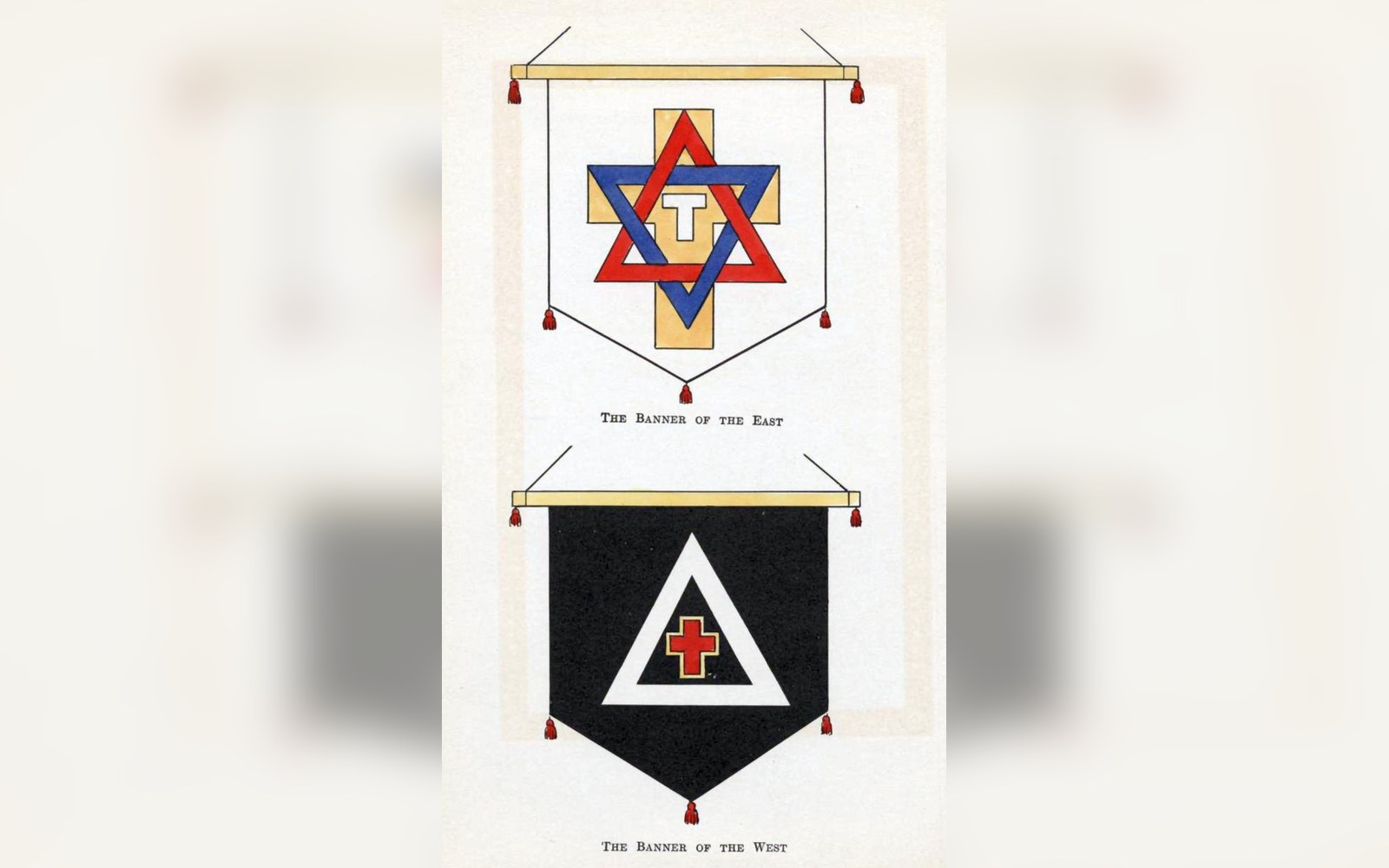
The Order taught the correspondences as grade material, with its own regalia and diagrams.
Photo: Israel-Regardie-Golden-Dawn-Vol-1-1937-Banner-Frontispiz · Wikimedia Commons
From Painting to Print
Harris completed the body of the deck by 1943. Crowley's accompanying text was privately printed in an edition of 200 copies the following year, the cards reproduced as colour plates. The broader publication history is one of delay: the paintings sat for decades before reaching mass-market print. Stuart Kaplan's U.S. Games Systems issued the deck in a format that made it available to general retail, and it has remained in continuous print since.
The Thoth deck's status in the publishing record rests partly on this production history: eighty paintings executed by a single artist over five years, entirely at her own expense, on a commission that carried no guaranteed publication and no advance. Harris retained no rights she could enforce. The three Magi in every printed box are the evidence that the work was driven by correspondence rather than contract, and that correspondence ended before the image did.