Pl. 02THE DRAWING
Waite Wrote the Brief, and the Pictures Are Not in It
The published record of what Arthur Edward Waite specified is thin. What Pamela Colman Smith drew is far richer — and the gap between the two is where the deck lives.
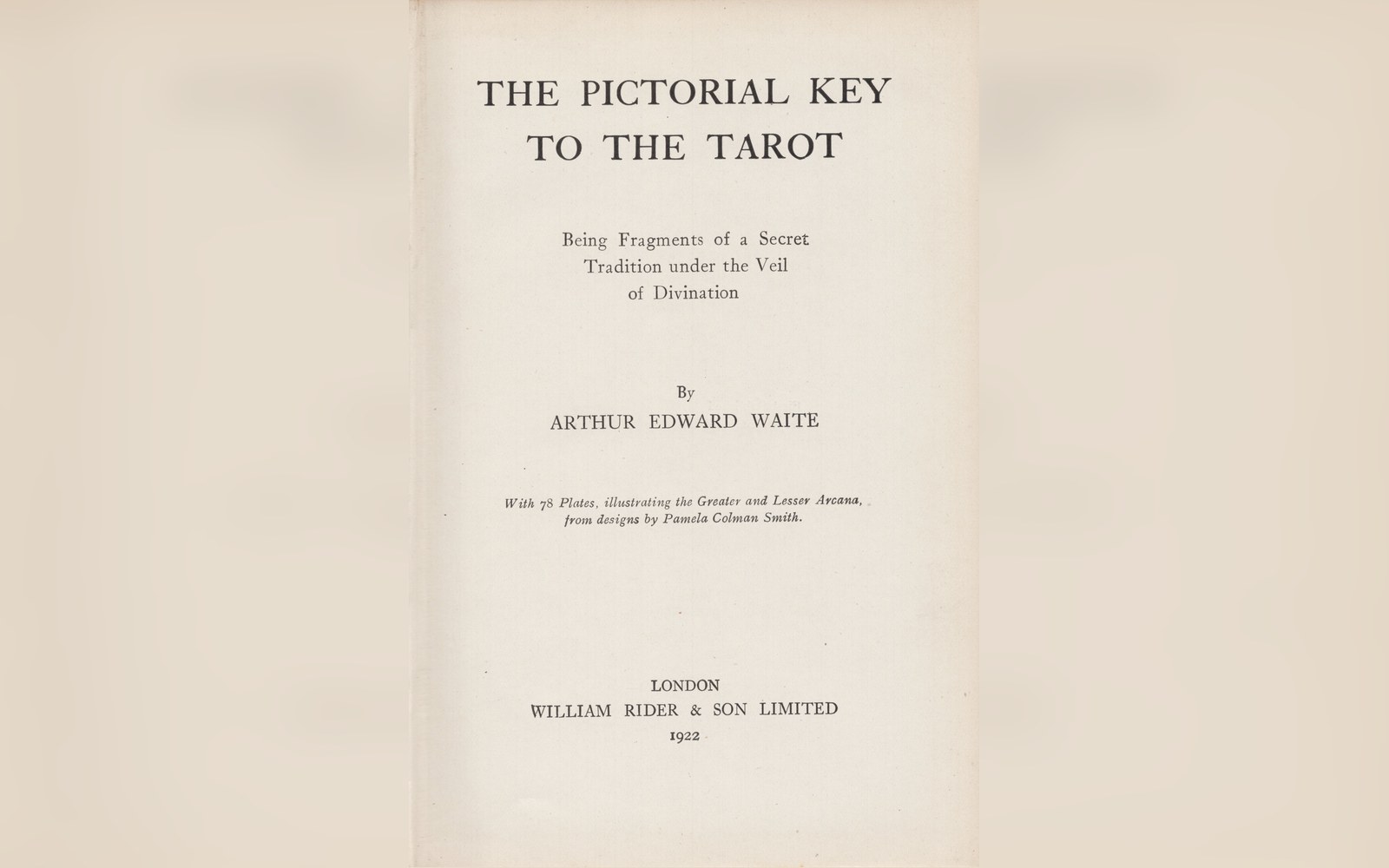
Waite’s 1922 companion volume credits the designs to Smith — on the title page, in small type, thirteen years after publication.
Photo: The Pictorial Key to the Tarot 1922 Title Page · Wikimedia Commons
What the Text Actually Says
Waite's The Pictorial Key to the Tarot, published by William Rider and Son shortly after the deck's first printing — is the closest thing to an authoritative commentary on the imagery he commissioned. It is not a design document. Much of it reads as interpretation after the fact, describing cards as a viewer might rather than as a director would. For the Three of Swords, Waite writes of "a heart pierced by three swords." That is the whole specification. For the Eight of Cups, he offers a figure walking away from stacked vessels toward a gap in the mountains, and notes the moon overhead. What he does not specify: the quality of moonlight, the slump of the departing figure's shoulders, the sense that something was abandoned rather than lost. Those are Smith's decisions.
The minor arcana — the fifty-six suited cards — presented the more consequential problem. Prior tarot packs showed pip cards as geometric arrangements of suit symbols without narrative scenes. Waite wanted illustrations, and the written record does not show him providing much to illustrate from. His diary and correspondence yield no detailed scene-by-scene programme for the pip cards. The Golden Dawn system, in which both Waite and Smith held membership, supplied astrological and elemental attributions, but attributions are not pictures. Smith turned those structural assignments into human figures doing legible, emotionally specific things — a choice that was hers to make in the absence of instruction.
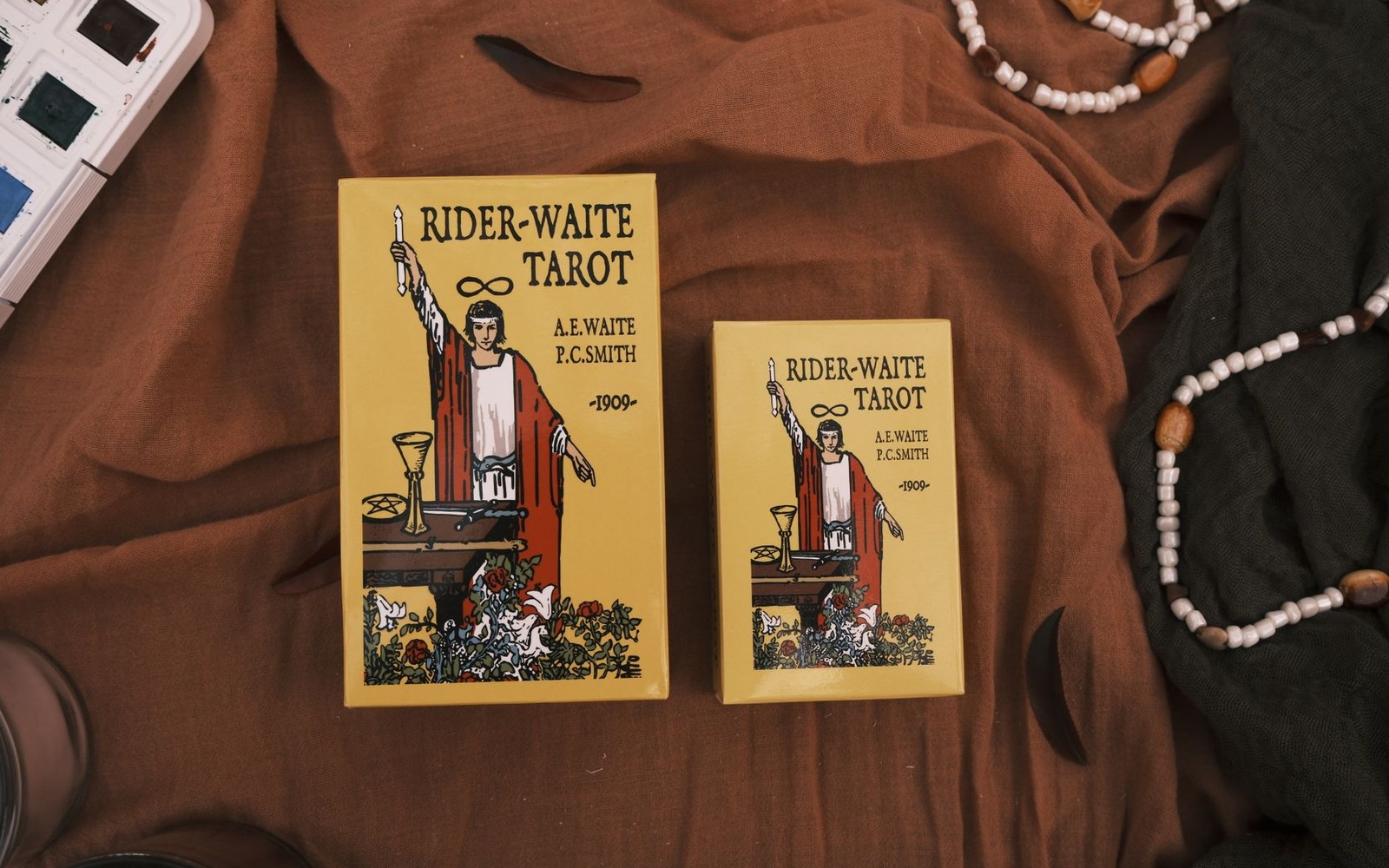
An early Rider printing. The illustrator’s name is not on the box.
Photo: dilara irem / Pexels
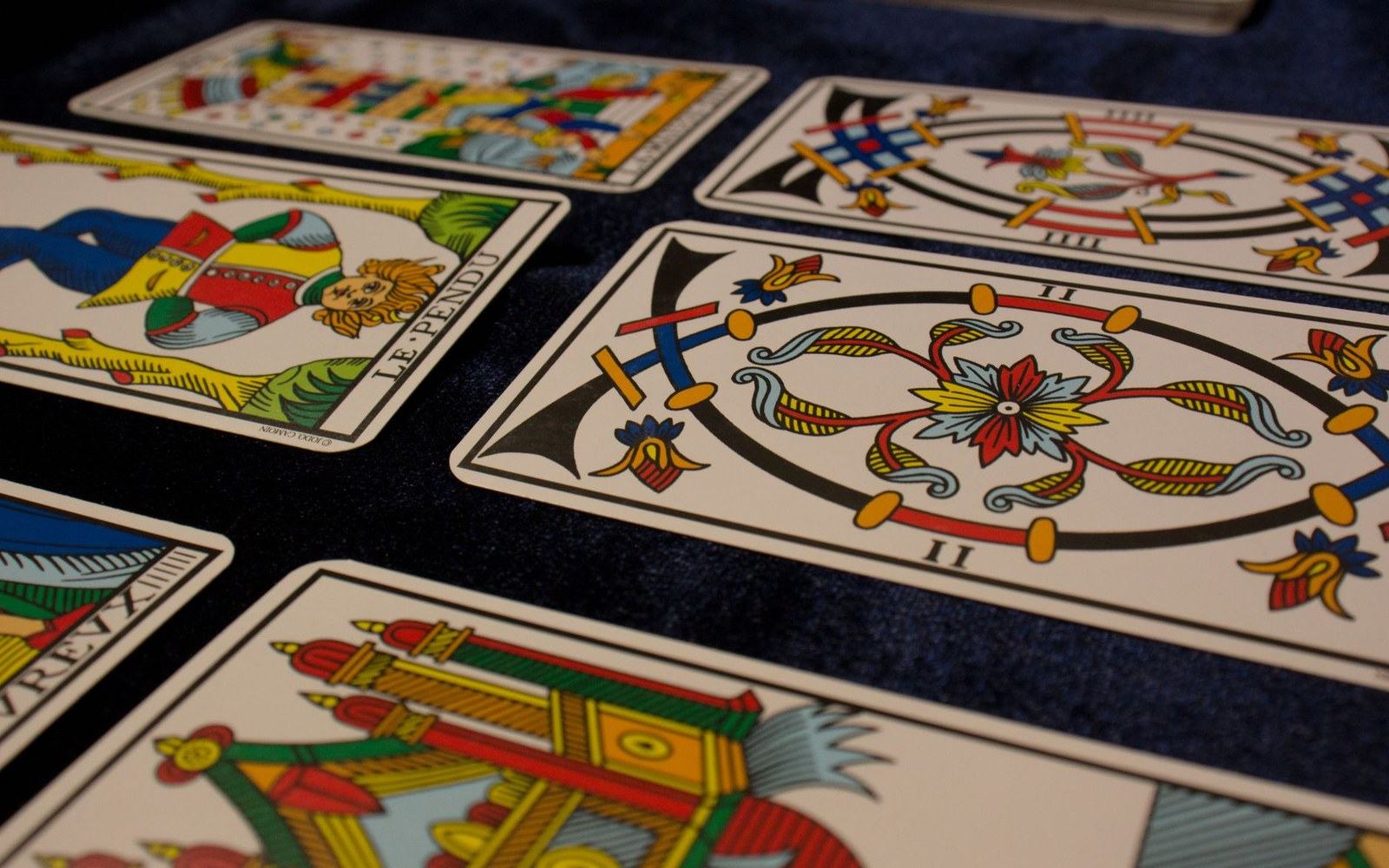
Before 1909 a numbered suit card looked like this: the symbol, repeated, arranged.
Photo: Pedro Rey / Pexels
The Invented Images
The card scholars have examined most carefully in this respect is the Ten of Pentacles, in which Smith placed an elaborate heraldic archway, two adults, a child, two dogs, and an elderly man in a patterned robe — all within a single card. No Waite text accounts for the composition's complexity or its multigenerational reading. The Six of Swords, showing a figure ferrying what appear to be a woman and child across still water, has no textual source in Waite's published writings that identifies the passengers or the destination.
Smith drew on sources Waite did not control: the theatrical staging she had absorbed working with Ellen Terry's company; the flat perspective and bold outline she had studied at Pratt Institute; the Sola Busca pack, whose complete illustrated minor arcana she had seen at the British Museum in 1907. These were inputs the commissioner did not supply and may not have anticipated. The resulting images are coherent, but their coherence is Smith's own synthesis.
The Commissioner's Limits
What the record shows is that commissioning an image does not produce it. Waite supplied a conceptual framework — the Golden Dawn ordering of the major arcana, the intent to illustrate the pip cards, certain named figures and objects — and Smith supplied everything that makes those cards visually legible across more than a century of subsequent reproduction. The brief, to the extent one existed in written form, was a set of constraints at the level of subject matter. The iconographic decisions that give each card its identity operated below that level.
This distinction matters for how the deck is understood as a physical object and a designed artefact: its authorship is distributed across a commissioner who published the interpretation and a maker who built the thing the interpretation was written about. The pictures are not in the Pictorial Key because they could not be. They were in Smith's hand.