Pl. 01THE MYTHOLOGY
Antoine Court de Gébelin, 1781
A Protestant minister with a theory about ancient Egypt looked at a card game and launched a myth that outlasted the scholarship that refuted it.
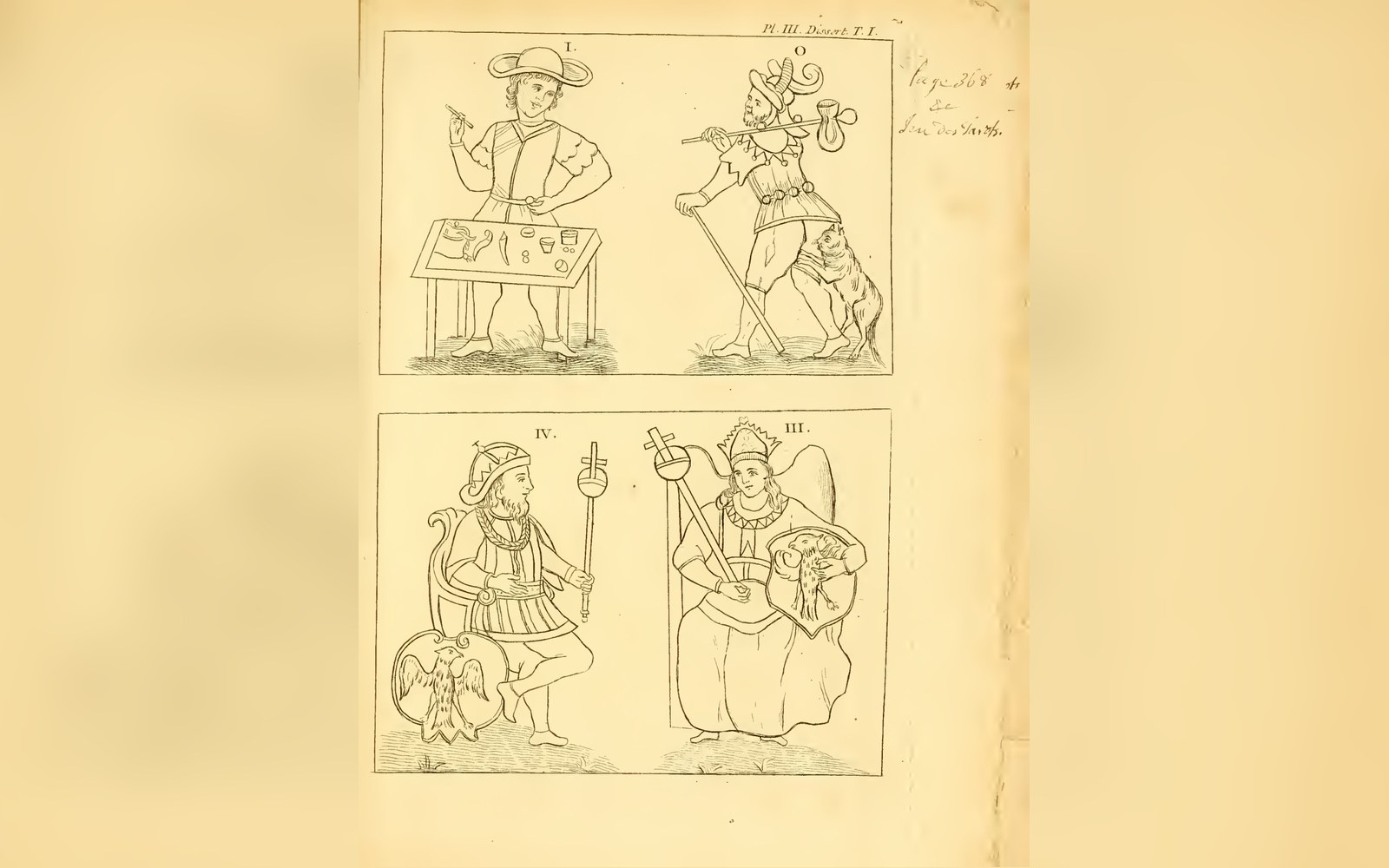
Plate III of the eighth volume: the Paris cards redrawn as evidence for a civilisation that was never there.
Photo: Court de Gébelin - Monde Primitif T. 8 Pl. 03 · Wikimedia Commons
The Volume, the Claim, and the Man
Antoine Court de Gébelin was not a charlatan. He was a Protestant pastor from the Cévennes, a fellow of the Académie de La Rochelle, and one of the more industrious comparative mythologists of the French Enlightenment. Between 1773 and 1782 he published Le Monde Primitif, analysed et comparé avec le Monde Moderne — a nine-volume encyclopedia attempting to reconstruct the universal primitive language and religion from which, he argued, all human cultures had descended. The eighth volume, which appeared in 1781, contained two short essays on the tarot. One was his own; a shorter addendum was contributed by the Comte de Mellet. Together they ran to under fifty pages within a volume that addressed dozens of other subjects. Their influence on the next two centuries was disproportionate to their length.
Court de Gébelin's central claim was this: the tarot cards being played in Paris drawing rooms — a game then fashionable among the French elite — were in fact the surviving leaves of an ancient Egyptian book, the Book of Thoth, a repository of priestly wisdom smuggled out of Alexandria and preserved, in plain sight, inside an Italian card game. He gave no archival source for this proposition because none existed. His argument was entirely inferential, running from the assumption that the imagery must be ancient because it was strange, and therefore must be Egyptian because Egypt was, in the Enlightenment imagination, the fountainhead of all esoteric knowledge.
The timing matters. The Rosetta Stone would not be discovered until 1799, and Jean-François Champollion would not publish his decipherment of hieroglyphs until 1822, forty-one years after Court de Gébelin wrote. In 1781, Egypt was a screen onto which European scholars could project almost anything. The ancient Egyptians could neither confirm nor deny. Court de Gébelin was a serious man working without the tools that would have corrected him, and in that gap he filled the silence with conviction.
The Argument Assembled from Parts
Court de Gébelin's specific claims about the cards can be sorted into three kinds: linguistic, iconographic, and numerological. His linguistic argument held that the word tarot derived from the Egyptian words tar (road or path) and ro (royal), yielding a Book of the Royal Road — an etymology that has no basis in any documented language and was invented on the page. His iconographic readings attached the major arcana trumps to Egyptian priesthood, cosmology and theology: the High Priestess was Isis, the Hierophant was Osiris, and so on down the sequence. His numerological argument dwelt on the number twenty-two, the count of major arcana cards, observing that it matched the number of letters in the Hebrew alphabet — a correspondence that would later become essential to Éliphas Lévi's far more elaborated Hebrew-letter system, though Court de Gébelin himself made only passing use of it.
The Comte de Mellet's addendum pushed the Egyptian fantasy further, proposing that the cards had travelled from Egypt via the Romani people — then identified in France by the term Bohémiens, from a mistaken belief that they came from Bohemia, though the actual proposed route in de Mellet's text ran through Egypt. This Romani-as-transmitter theory had the same evidentiary status as the rest: none. The actual origin of playing cards in Europe — through the Mamluk sultanate's paper workshops, arriving in the Italian peninsula in the late fourteenth century — was a history that Court de Gébelin's contemporaries lacked the documentary apparatus to reconstruct. The Mamluk pack in the Topkapı Sarayı Museum in Istanbul would wait another century and a half before its significance as the oldest well-preserved ancestor of European card suits was fully assessed.
What Court de Gébelin got wrong about the cards themselves is also worth noting. He described the tarot he saw as an ancient survival; it was, in all probability, a Tarot de Marseille pattern of fairly recent cutting, a descendant of the Italian tarocchi that had crossed the Alps and standardised into the Marseille woodblock tradition during the preceding two centuries. He also misidentified the card he called La Papesse — the High Priestess — as a straightforwardly Egyptian female hierophant, when the figure had documented iconographic roots in the legend of Pope Joan and in late-medieval Italian Catholic imagery. He worked from what he could see, and he saw it through the only interpretive frame available to an eighteenth-century comparative mythologist with Egyptian enthusiasms.
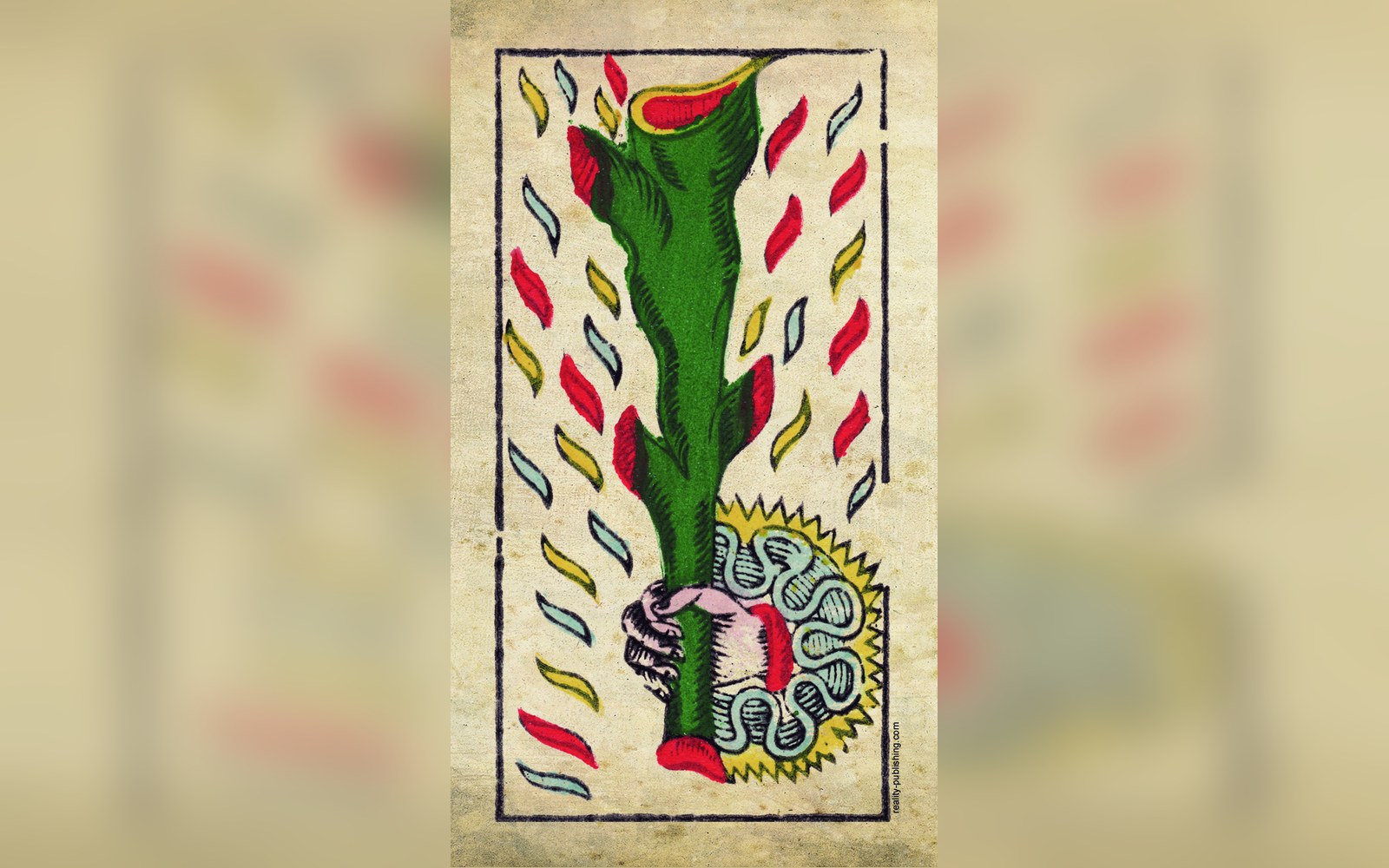
A pull from the Conver line — the Ace of Batons, still in print.
Photo: As BATON Nicolas Conver Tarot 1760 · Wikimedia Commons

The suit marks travelled into Europe; the trumps were added later, in Italy.
Photo: Erik Mclean / Pexels
Why the Error Propagated
Court de Gébelin's essays circulated in the years immediately after publication to an audience well-prepared to receive them. Paris in the 1780s was thick with Freemasonic lodges, mesmerist salons, and esotericists of various persuasions; the idea that an apparently trivial card game concealed ancient wisdom was not merely plausible but welcome. The fortune-teller Jean-Baptiste Alliette, who published under the anagram Etteilla, was the first to fully commercialise the Egyptian theory, producing a redesigned deck in the late 1780s explicitly based on Court de Gébelin's claims, with cards renumbered and re-illustrated to match what Etteilla imagined an Egyptian original should look like. Cartomancy — reading meaning from cards — acquired, through Etteilla's publications, an air of priestly antiquity it had not previously possessed.
The claim's propagation through the nineteenth century depended less on Court de Gébelin's text than on secondary citation. Éliphas Lévi, publishing in 1854 and 1856, cited the Egyptian origin as established, added the Hebrew-alphabet correspondence, and built a system of occult philosophy on top of it. The Hermetic Order of the Golden Dawn, founded in London in 1888, took Lévi's synthesis as foundational. By the time Pamela Colman Smith drew the deck that Arthur Edward Waite published in 1909 — the deck that would define tarot's visual vocabulary for the next century — the Egyptian origin story was so embedded in occult tradition that questioning it would have seemed eccentric. The myth had calcified into doctrine.
The scholarly dismantling came gradually. By the mid-twentieth century, card historians examining the actual documentary record of playing cards in Italy, France, and Germany had established that the tarot's structure was Italian, that its earliest surviving examples dated to the fifteenth century, and that no Egyptian connection of any kind was demonstrable. The research is not contested. Court de Gébelin's Egyptian hypothesis has no support in the historical record, and has not had any since Champollion made the actual Egyptian textual record legible in 1822.
What persists is not the argument but the imaginative frame it built. The image of tarot as a vessel of encoded ancient wisdom proved more durable than the evidence for it, because it gave the cards a function that a game history could not — a sense of depth, of hidden meaning, of transmission across time. Court de Gébelin did not invent tarot. He invented the idea that it was something other than what it was, and that idea has been in print ever since.