Pl. 05COLLECTIONS
Nicolas Conver Cut His Blocks Around 1760, and Every Edition Still Argues With Them
The Marseille pattern is not a design — it is a set of tooling marks, accumulated across ink pulls and sharpened edges, that no digital scan fully settles.
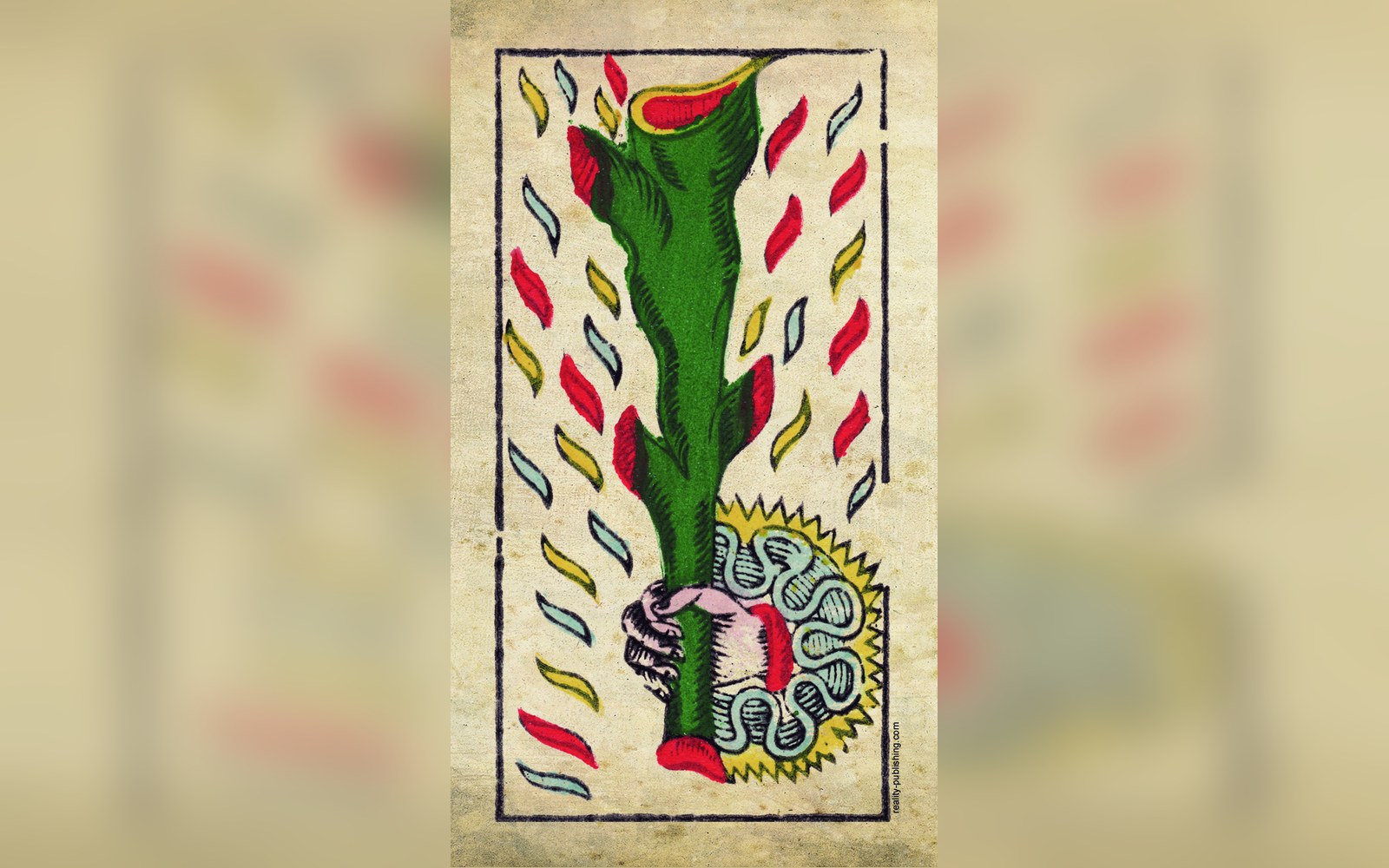
A pull from the Conver line — the Ace of Batons, still in print.
Photo: As BATON Nicolas Conver Tarot 1760 · Wikimedia Commons
What Conver Made, and What Survived
Nicolas Conver was a card-maker in Marseille who produced a standard pack — the type already known as the Tarot de Marseille — and dated his title card 1760. The blocks themselves were woodcuts, following the convention of French cartiers (card-makers) who cut designs into pear or fruit wood and pulled impressions in black ink before stencilling colour by hand. Conver did not invent the Marseille pattern; a stable arrangement of imagery, suits, and roman-numeral trumps had circulated among southern French and northern Italian makers for at least a century before him. What he did was cut a version that survived physically, and survival is the whole of the story.
The blocks passed through successive owners as the Marseille trade consolidated and then contracted in the nineteenth century. The pattern — its pip-card geometry, its court-card postures, the particular weight of its trump figures — remained in commercial use long after hand-stencilling gave way to lithography, and long after Marseille itself stopped being a card-making centre of consequence. What made the Conver blocks consequential was not that they were the best surviving example of the type but that they were a surviving example at all, in a condition that still permitted study and, eventually, reproduction.

Wear in the block is the thing every Marseille restoration has to take a position on.
Photo: Mehmet Turgut Kirkgoz / Pexels

The Fool carries no numeral in the Marseille sequence — the gap is the whole argument.
Photo: Costumed participant holding chalice and The Fool tarot card at Wyldwood Renaissance Festival 2026 · Wikimedia Commons
The Argument Compressed into Every Modern Edition
When Héron, the Paris-based card publisher, issued a twentieth-century Marseille edition derived from the Conver source, it became the version most widely encountered in French homes for decades. The problem any restorer faces is that a woodblock wears with each impression: lines close slightly, ink fills narrow channels, and the block as it stood after ten thousand pulls is not the block as Conver finished cutting it. Every edition printed from the Conver source is therefore a print of a worn object, and every editorial decision — how much to clean the image, whether to sharpen a line that has blurred, whether to accept a gap as intentional or read it as damage — is an argument about what Conver intended versus what the block became.
The most discussed modern restoration is the 1997 edition produced by Camoin and Jodorowsky, who had worked from the surviving Conver deck and made explicit choices about which wear to honour and which to repair. Alejandro Jodorowsky and Philippe Camoin's version sparked sustained debate among researchers precisely because it was not a facsimile — it was an interpretation, presented as a restoration. The Bibliothèque nationale de France holds reference impressions from the Marseille tradition that allow comparison with pre-restoration states, and that comparison is the documentary record against which any claimed restoration stands.
A separate line descends through Italian publishing. Lo Scarabeo, the Turin-based card producer, released a facsimile edition of the 1760 Conver deck that made different editorial choices, keeping closer to the physical state of the source without the sharpening interventions the Camoin-Jodorowsky edition applied. The two editions are printings of the same originating blocks read through opposed theories of what a facsimile owes its source.
The 78-card structure — twenty-two major arcana and fifty-six minor arcana — that Conver encoded into his blocks remains the structural standard the Marseille pattern transmits to every edition. What varies is the surface: the exact width of a line, the density of a hatched shadow, the colour separations applied after printing. Researchers who want to read the blocks as Conver cut them must work backward through all subsequent impressions, none of which is innocent of wear, ink, or editorial will.
The Marseille pack, in this sense, is not a stable text. It is a record of use, and Conver's 1760 date marks not a fixed moment but a point of departure from which every subsequent printing is a measurable distance.