Pl. 02COLLECTIONS
What the Morgan Library Holds, and How It Got There
The Morgan's fifteen Visconti-Sforza cards are the largest surviving fragment of the pack in one place — and their acquisition history is as layered as their gilding.
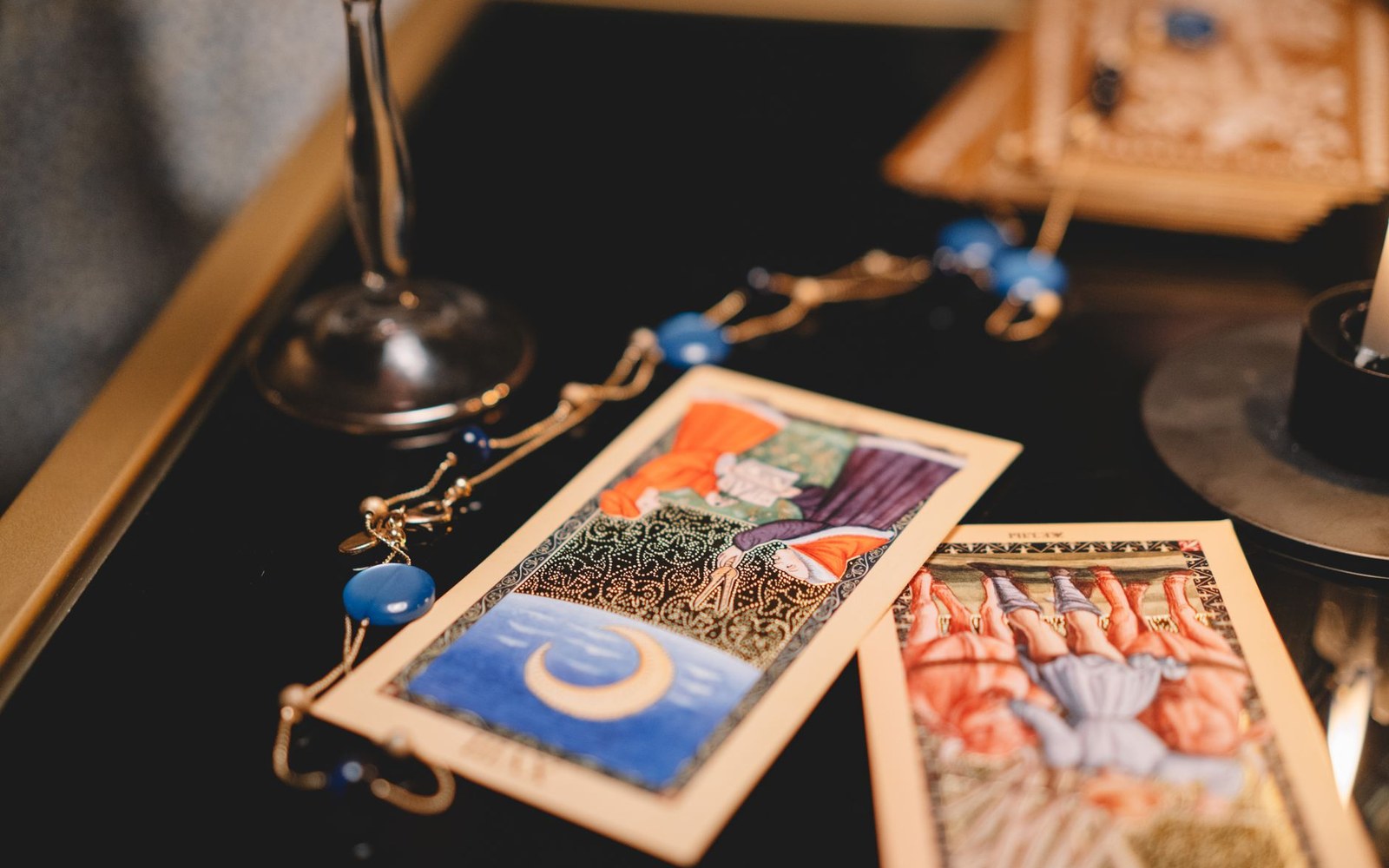
Gold ground, punched and tooled: these cards were made for a court, not a card table.
Photo: cottonbro studio / Pexels
From Milan to Madison Avenue
The Visconti-Sforza tarot, painted in Milan in the mid-fifteenth century, survives in fragments across three institutions on two continents. The Morgan Library and Museum in New York holds a substantial group of the surviving cards — acquired through the collecting of the Morgan family, in the early years of the Library's history. The cards entered the collection as MS M.630, a designation that places them formally in the manuscript holdings rather than in a prints-and-drawings category, a classification that already signals something about how the Library understands them: not as games material but as illuminated objects.
The attribution to the Milanese court workshop has been strengthened by the Morgan's own cataloguing. Conservation examination of the cards has confirmed the use of raised gold — punched and tooled, not simply gilded flat — consistent with the technique of painters working for the Visconti and later the Sforza dukes. The cards are on gilded pasteboard, not paper, and their dimensions sit at the larger end of what fifteenth-century Italian card-makers produced. The Morgan's records note that paint layers include ultramarine of high quality, consistent with expensive pigment procurement at a ducal level.
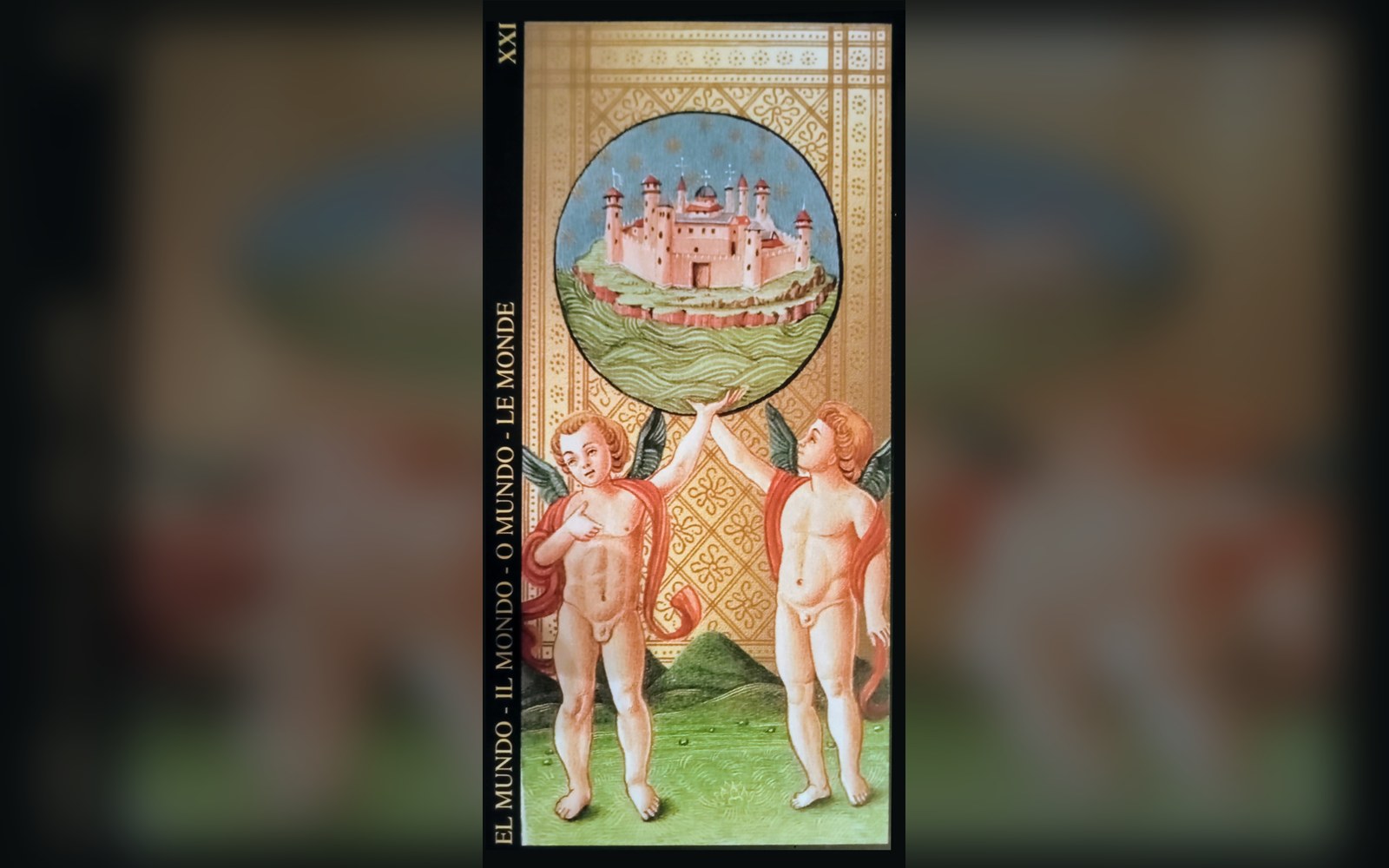
Trump XXI, from the largest surviving portion of the pack.
Photo: Arcana N°21 card in Visconti Sforza tarot deck (scan 2025) · Wikimedia Commons
Conservation terms, not display terms: low light, flat mounts, no handling.
Photo: mali maeder / Pexels
Authorship remains a documented uncertainty. Scholarly attention has pointed toward Bonifacio Bembo, a Cremonese painter known to have worked for the Sforza, though the attribution carries ongoing qualification because the cards were produced across more than one campaign and possibly more than one hand. The Morgan's catalogue entry does not force a single-artist conclusion; it records the evidence and leaves the question appropriately open.
What the Library's holding contributes, within the limits of an incomplete pack, is evidence for the sequence. The fifteen cards include several major arcana — the trumps from which the modern major arcana descend — and their survival as a coherent group allows iconographic comparison with the cards held in Bergamo and in private hands. That comparison has been central to reconstructing the original seventy-eight-card structure, or something close to it, because no single collection holds a complete pack.
Conservation treatment at the Morgan has been minimal and documented: surface cleaning, stabilisation of lifting paint, and housing in individually cut mounts. The cards are not on permanent display but are available to researchers, and facsimile editions produced from the Morgan's holdings have carried the Library's catalogue scholarship into print, making the physical evidence accessible without risk to the originals.